How Singers Read Charts and Learn Parts
Guides adult singers through lead sheets and vocal charts, covering melody lines, chord symbols, form, counting, and efficient practice routines.
By the District Songbook editorial teamPublished Revised Reading 8 minutes
Reading a chart in an adult vocal jazz group is a practical skill. You learn to follow the melody, the chord symbols and the form, then you use the page to hold your part between rehearsals.
What a lead sheet actually gives you
You will often sing from a lead sheet rather than a full classical part. In jazz the page gives basic indications of melody, chord changes and arrangement, and many elements of the performance stay improvised even when the group has that page in front of it. Sheet music in this sense is a handwritten or printed form of musical notation that uses symbols to show pitches, rhythms or chords of a song. The paper does not replace listening. It records the outline so singers, a pianist, a guitarist and a bassist can start from the same place. For more background on how ensembles rehearse together, keep that outline in view and let your ear do the rest.1
How do you find your way around the page?
Start at the top and read the credits before you sing a note. Sheet music from the 20th and 21st centuries typically shows the title on a title page, a cover or at the top of the first page when no separate title page exists. If the songwriter or composer is known, the name is typically shown with the title. The page may also name the lyricist when the words are by another person, and it may name the arranger when the song has been arranged for publication. Old folk songs, blues and bluegrass songs, and very old hymns and spirituals may show no writer because the authors are often unknown, and the word traditional often stands where the name would go. Title pages for songs may carry a picture tied to the characters, setting or events in the lyrics.
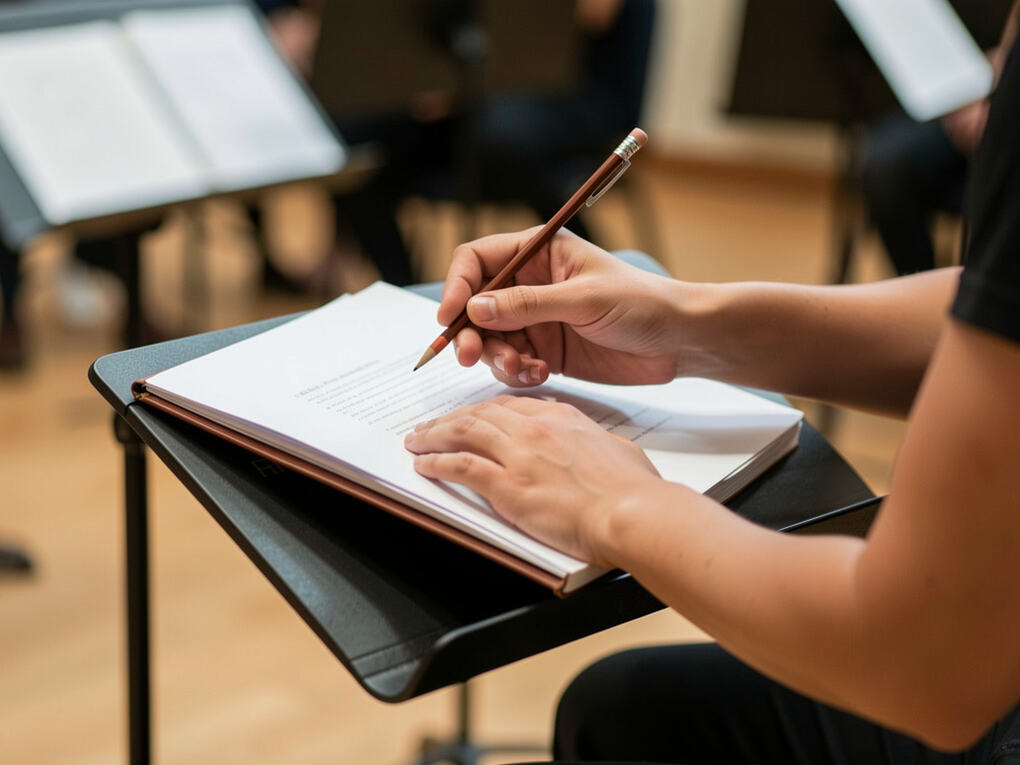
Why paper still matters when voices learn by ear
Many forms of traditional and popular Western music are commonly learned by ear rather than from notation, although that music may also be available in printed form. Singers in many popular styles learn a song from a lyric sheet and take the melody and rhythm from a recording. That habit works in vocal jazz too, because phrasing lives in listening. Use the page as a record, a guide and a means to perform the song. If you forget an entrance, the notation shows where your line sits. If you remember the sound but lose the place, the bar lines and the form bring you back. Paper and ear support each other instead of competing.2
What the staff tells you at a glance
In most classical-style notation the melody and the accompaniment are written on a staff with round note heads. Look for a clef such as the treble clef or bass clef, then a key signature that shows the key. A signature with four flats is typically used for the key of either A-flat major or F minor. Then look for a time signature, which typically has two numbers aligned vertically. The lower number shows the note value that stands for one beat and the upper number shows how many beats are in a bar. A common signature shows four quarter notes per bar, and some common signatures also appear as non-numerical shorthand, where a large C stands for common time. Lyrics, when present, sit near the melody notes.
In most classical-style notation the melody and the accompaniment are written on a staff with round note heads.
District Songbook, How Vocal Jazz Ensembles Work
Why tempo says slow blues or fast bop
Songs and pieces from the Classical period onward indicate tempo with an expression, often in Italian, such as allegro for fast or grave for slow, along with dynamic markings. Music from the Baroque era or earlier may have neither a tempo marking nor a dynamic marking, because singers and players of that time were expected to know the practice from experience. Later composers often used their own language, such as fast or schnell, or added metronome markings for beats per minute. Those habits carry into popular song. The broad guide to printed notation for songs explains how versions of 20th- and 21st-century popular songs often show both tempo and genre, such as slow blues or uptempo rock. Jazz tunes do the same, such as slow blues or fast bop, so read that line as a style instruction and set your breath and tone to match.3
What do chord symbols ask singers to do?
Pop songs often print chord names above the staff as letter names, such as C Maj, F Maj or G7, so a guitarist or pianist can shape an accompaniment. Many jazz tunes use chord charts that show the chord progression and the form, such as C, A7, D minor and G7. Players in a rhythm section, including piano, guitar and bass, use that chart to guide improvised accompaniment, while lead instruments such as saxophone or trumpet use the changes to guide solo lines. As a singer, you do not have to play every chord, but you need to hear where the harmony moves. Notice the same logic in charts that use numbers or Roman numerals, such as I to IV to V, which blues, R&B, rock and heavy metal players also use. Some charts give no rhythmic detail, while others use slashes for beats in a bar and written rhythms for syncopated hits the writer wants the whole band to play together. Your job is to place your entrance inside that frame. For how harmony sits across sections, read voice parts and harmony explained.
How do scores and parts keep a group together?
A single line for one voice is a part. When separate instrumental and vocal parts are printed together, the result is called a score. By convention, a score shows each part in vertical alignment, so events that happen at the same time stand in parallel. The term score is also used for sheet music written for only one performer, but the distinction between score and part matters when more than one part is needed for performance. Modern sheet music for one instrument or voice, such as a solo piece or an a cappella solo, may be written on one page. A piece for more than one person usually gives each singer or player a separate part, which is the usual case for works that need more than four performers, although a full score is also published. A full score shows the music of all voices or instruments lined up in a fixed order in a large book that a conductor can read while directing.
What makes a page easy to read on the stand
The purpose of an edition changes its layout. A study copy for a music history class can use smaller notes and staves because no one worries about page turns. A performance page needs notes that stay readable from a music stand, with few page turns, and turns placed after a rest or pause when possible. A score or part in a thick-bound book will not stay open, so a performance copy needs a thinner binding or a format that lies open on the stand. You can help yourself by keeping your copy flat, by enlarging a reduced page before rehearsal and by checking that computer screen scores stay legible under room light. Access to notation since the 1980s has included scores on screens and scorewriter programs that notate a song electronically and can in some cases play it back with a synthesizer or virtual instruments. Use that playback to check pitches, then put the sound aside and sing the line without support.
How do you practice between rehearsals without wasting voice?
Sight reading is the ability to perform an unfamiliar work at first sight, and it is expected of professional musicians and serious amateurs in classical music, jazz and related forms. A further skill is to look at a new piece and hear much of the sound in your head, including the melody, harmony and tone color, without playing or hearing it. Skilled composers and conductors have that skill. You can build toward it in small steps. Point to each phrase, sing it slowly on a neutral syllable, then add the words once the intervals feel secure. Guitar and bass players often use tablature, which shows which frets and strings to play, and many rock and heavy metal players rely on that graphic form. Singers can borrow the idea by marking fret-like landmarks on paper, such as chord tones, breaths and repeated hits, and by learning the melody by ear from a recording when only a lyric sheet is at hand. Talk with directors and rhythm players about repeats, endings and who cues each section, then write those cues in the margin.
Bring a pencil to the next rehearsal, sing your marked part softly against the rhythm section, and adjust one phrase at a time until the form holds without effort.