Jams and Open Mics for Singers
How jazz jams and open mics work for a singer: the sign up list, choosing a key with a house band, what to prepare and how a first sit in goes.
By the District Songbook editorial teamPublished Revised Reading 6 minutes
You have learned your parts, you can hold your line in a section, and now you want to sit in with players you have never met. A jazz jam or an open mic for singers works on a small set of conventions: how you get on the list, how keys get called, what a house band expects of a voice, and what you carry with you. Learn those few things and the room stops being a closed door.
The phrase itself has a history worth knowing before you walk into one. A jam session is a relatively informal musical event, process or activity where musicians, typically instrumentalists, play improvised solos and vamp over tunes, drones, songs and chord progressions, and to jam is to improvise music without extensive preparation or predefined arrangements.
What actually happens at a jazz jam
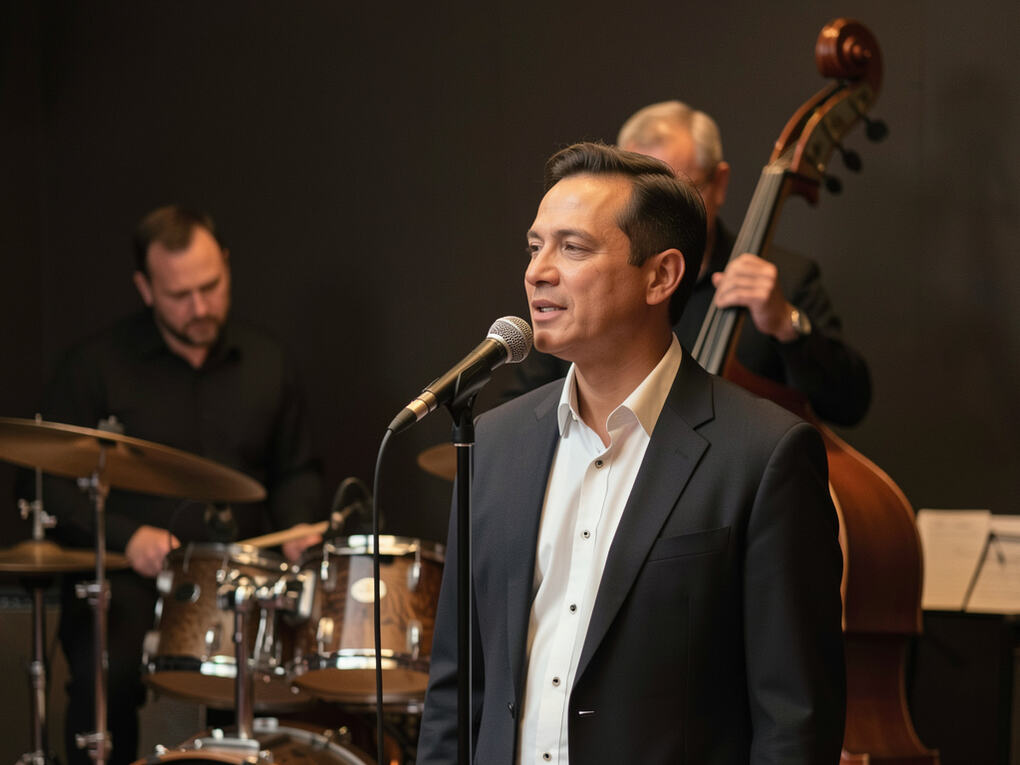
The usual shape of an evening is simple. A rhythm section holds the stage, a host or coordinator keeps the order, and singers and instrumentalists are called up in turn. One account of the phrase places its origin in the 1920s, when white and black musicians would gather after their regular paying gigs to play the jazz they could not play in the "Paul Whiteman" style bands they played in. The same account says that when Bing Crosby attended these sessions, the musicians would say he was "jammin' the beat," since he would clap on the one and the three.
That after-hours character still shapes the etiquette. You are a guest in someone else's working evening, and the room rewards preparation over volume.
How do you sign up for a song?
Sign-up practice varies by room. The page on jam sessions describes the range plainly: such gatherings can run from very loose meetings of amateurs to evenings where a coordinator or host acts as a gatekeeper so that performers of an appropriate level take the stage, and up to sophisticated improvised recording sessions by professionals. For a singer, that means the list may be a sheet on the bar, a nod to the host, or an invitation that never comes.
Bluegrass practice offers a useful comparison, because it is unusually explicit about levels. Bluegrass jams tend to be segregated by the skill level of the players; slow jams for beginners provide an entry point, open jams are open to all comers but the players will expect a certain level of proficiency, and jams that require advanced proficiency are generally private events, by invitation only. Jazz rooms rarely label themselves this clearly, so ask the host where a first sit-in belongs.
Keys, charts and the moment the count-off lands
A jam may be based on an existing song, loosely based on an agreed chord progression or chart suggested by one participant, or wholly improvisational. In practice the singer is usually the one who names the tune and the key, because the horn players and the pianist need that information before the first bar. Say the title, say the key, and if the arrangement is unusual, say that too. A lead sheet in your bag settles the question faster than a discussion.
Expect the tempo to be set by the band, not by you. If you have only ever sung a ballad at a slow rehearsal pace and the drummer counts it in briskly, follow the band and keep the shape of the melody rather than fighting for your usual speed.
What does a house band give a singer?
A house band gives you three things you cannot supply alone: a harmonic frame, a steady pulse, and a known ending. The band also protects the evening. Where a host acts as gatekeeper, that person is deciding how long each performer stays up and who is ready for which tune, which is why a first visit is a good moment to listen more than you sing.
A house band gives you three things you cannot supply alone: a harmonic frame, a steady pulse, and a known ending.
District Songbook, Singing in Washington DC
The pages of history show how serious these rooms can get. The New York scene during World War II was famous for its after-hours jams, and one of the most famous was the regular after-hours jam at Minton's Playhouse, which ran in the 1940s and early 1950s. Those sessions were a meeting place and proving ground for established soloists such as Ben Webster and Lester Young alongside younger players who would soon lead the bebop movement, including Thelonious Monk, Charlie Parker and Dizzy Gillespie. The Minton's jams had competitive "cutting contests," in which soloists tried to keep up with the house band and outdo each other in improvisational skill. Nobody expects that of a newcomer, but it explains why the room listens closely.
Is an open mic the same thing as a jam?
No, and the difference matters for what you prepare. An open mic night is a sequence of short turns in front of an audience; a jam is an improvised collaboration with players who may change the arrangement under you. Some evenings combine both, which is why a host asks whether you are bringing a chart or singing with the band by ear.
The two formats also differ in what you can control. On an open mic you can usually choose your tempo and your accompaniment. At a jam you hand those decisions to a rhythm section you may have met ten minutes earlier.
What should a singer bring to a first sit-in?
Bring the smallest possible kit. A chart or lead sheet for each tune you intend to call, in the key you actually sing, with the form marked. A lyric sheet for yourself, because nerves erase second verses. Water. A way to take notes on what the host tells you about the next session.
Before you arrive, decide on two tunes and no more. One should sit comfortably in the middle of your range and one should be slightly challenging, so that if the first goes well you have somewhere to go. Know the melody without the words in front of you, and know where the form turns.
What do experienced singers listen for before they walk up?
They listen to the room's level of proficiency before they judge their own. The abilities to hear chord progressions and keep time are treated as essential in bluegrass jams, and the ability to play improvised leads that contain at least a suggestion of the melody is considered desirable; a singer is judged on the same two essentials, pitch against the harmony and time against the drummer.
They also listen to how the host introduces people and how the band responds, because a rhythm section that locks in easily will carry a first-timer further than one that does not. Arrive early enough to hear the first two or three turns and you will know what the evening will accept.
Before the next session, choose the one tune you will call first, write the key on the corner of the chart, and put both in your bag tonight rather than the morning of. Singing in Washington places the jam among the other places adults sing in the region, and the looser formats outside a church setting cover the rest.