Your First Rehearsal, Step by Step
A new singer's first rehearsal, from what to bring and where to sit to how sections are placed, how a director counts in and how to follow the folder.
By the District Songbook editorial teamPublished Revised Reading 6 minutes
On a first rehearsal, the smallest details decide whether you sing well or spend two hours guessing. Here is what to carry in your bag, where to put yourself in the room, how sections are laid out and what a director's count-in actually tells you to do.
The evening starts before you sing a note. A new singer walking into an adult ensemble for the first time is not expected to know the room, the seating or the vocabulary. A rehearsal is a working session, not a test, and the people around you are there to build the same piece you are. If you arrive knowing what to bring and where to stand, you can spend the two hours on the music instead of on logistics.
What actually goes in the bag
Singers carry less than they think. A pencil is not optional: directors stop, ask for a change, and expect it marked on your own copy. A water bottle at room temperature is standard kit. Music lives in a folder or a binder so charts stay flat and in order, and a small notebook or a phone note catches room changes and section reminders.
Anything else depends on the ensemble. Some groups hand out printed arrangements, others expect singers to read from a tablet. Ask before the first session which one applies, because a singer who shows up without a pencil spends the rehearsal borrowing one.
Where to sit when you do not know anyone
Sit where you can see and hear the person leading. In most rooms that means not the back row and not the far edge of a section. If the group uses risers, take a spot in the middle of your voice part rather than at the end: you will hear the people around you, and your neighbours will hear you, which is how a blend gets built in the first place.
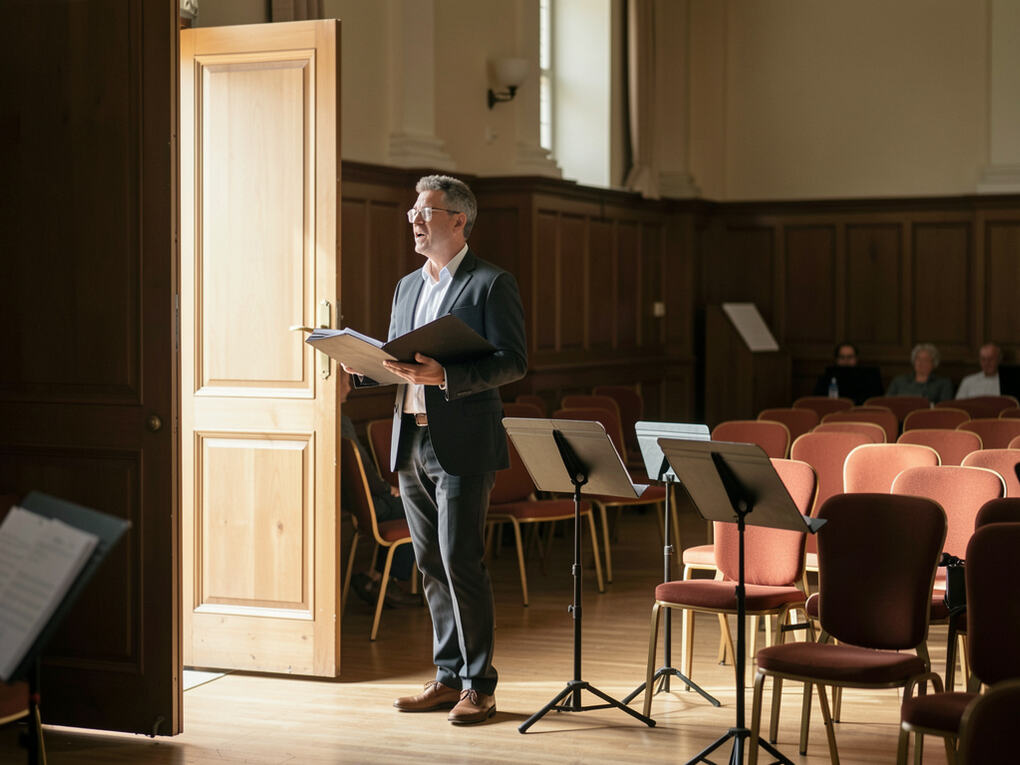
You do not need to claim a permanent seat on the first night. Most ensembles settle into a rough arrangement over a few weeks, and a new singer who sits in a slightly different spot each time learns the room faster.
How sections are placed in the room
Layout follows one practical rule: voices that need to hear each other sit together. In a mixed ensemble the parts are grouped as sections, and the grouping usually mirrors how the harmony is written. Sopranos and altos occupy one block and tenors and basses another, or the parts alternate left to right so that no section is stranded behind another.
When the ensemble is preparing a piece with orchestra, the sections may be rearranged entirely to leave space for the players. If the seats move between rehearsals, that is normal, not an accident. A section that stands together can tune to its own neighbours before it tunes to the whole room.
Does everyone rehearse the same way?
No, and the difference is worth knowing before you judge yourself against the room. Professional ensembles typically rehearse a work for only two or three sessions, held several days before the first performance, and they spend that time on the passages that create rhythmic or harmonic trouble rather than playing the piece from start to finish. Amateur groups, by contrast, may take ten or even fifteen rehearsals over several months to prepare a major work, and the person leading spends far more time teaching.
No, and the difference is worth knowing before you judge yourself against the room.
District Songbook, How Vocal Jazz Ensembles Work
The Wikipedia page on rehearsal covers the technical runs and the dress rehearsal that close a production, along with the working sessions that come first. That gap is the whole reason a newcomer should not measure a first rehearsal against a professional recording. Amateur singers are more likely to make note mistakes, transpose by accident or drift in intonation, and the conductor's job is to point those out and show how to correct them. Rehearsals in an amateur ensemble also carry a second purpose: teaching music history and performance practice so that singers learn the styles and tones of different eras, and choosing repertoire that stretches the group into new rhythms.
Sectional rehearsals and the parts of the room you did not expect
Some rehearsals are not full ensemble at all. A sectional is a session for one voice part on its own, led by the principal player in an orchestra or by a section leader in a choir, and amateur groups hold far more of them than professional ones. If your first rehearsal turns out to be a sectional, you are not missing the main event; you are getting the version of the evening built specifically for your part.
A choir preparing a piece to be sung with an orchestra may find that early rehearsals are led by the choir's own conductor and the sessions closer to the concert by the orchestra's conductor. Nothing has gone wrong. The leadership simply changes hands as the performance gets nearer.
What a count-in tells you to do
The count-in is not decoration. It sets the tempo and the moment of entry. For orchestral, solo or chamber work, a metronome may sound the tempo before a piece begins, which is why some directors give you a click and some give you a bar of counting. In a prepared ensemble, the person leading calls out bar numbers or rehearsal letters to send the group to a specific place in the score.
During a rehearsal, that person talks. Conductors do not usually speak to an orchestra during a concert, but in the rehearsal room they speak constantly, describing the artistic shape of the piece, the articulation, the tone colors and the tempos they want. When the ensemble is stopped and sent back, it is not a penalty. The working habits of an adult ensemble are built on stopping, correcting and starting again, and a director is expected to halt the group as often as the music needs.
Where the first evening ends and the season begins
A dress rehearsal comes last. It is a full-scale run-through in which the ensemble performs every detail as it will in front of an audience, working through the whole piece from beginning to end including pauses for intermissions. In theatre the cast wears costume and may use props and backdrops, and the actors work without scripts, though the stage manager and director may still hold theirs. In music the dress rehearsal does not require concert dress such as tuxedos and gowns, and it is usually the final session before the performance, falling at the end of technical week. Some groups invite a limited audience, often students or guests.
You do not need any of that on night one. Bring the pencil, take a seat where you can see the person leading, listen for your section and count with everyone else. The rest of the calendar arrives on its own schedule.